
Experiments
My Experiments
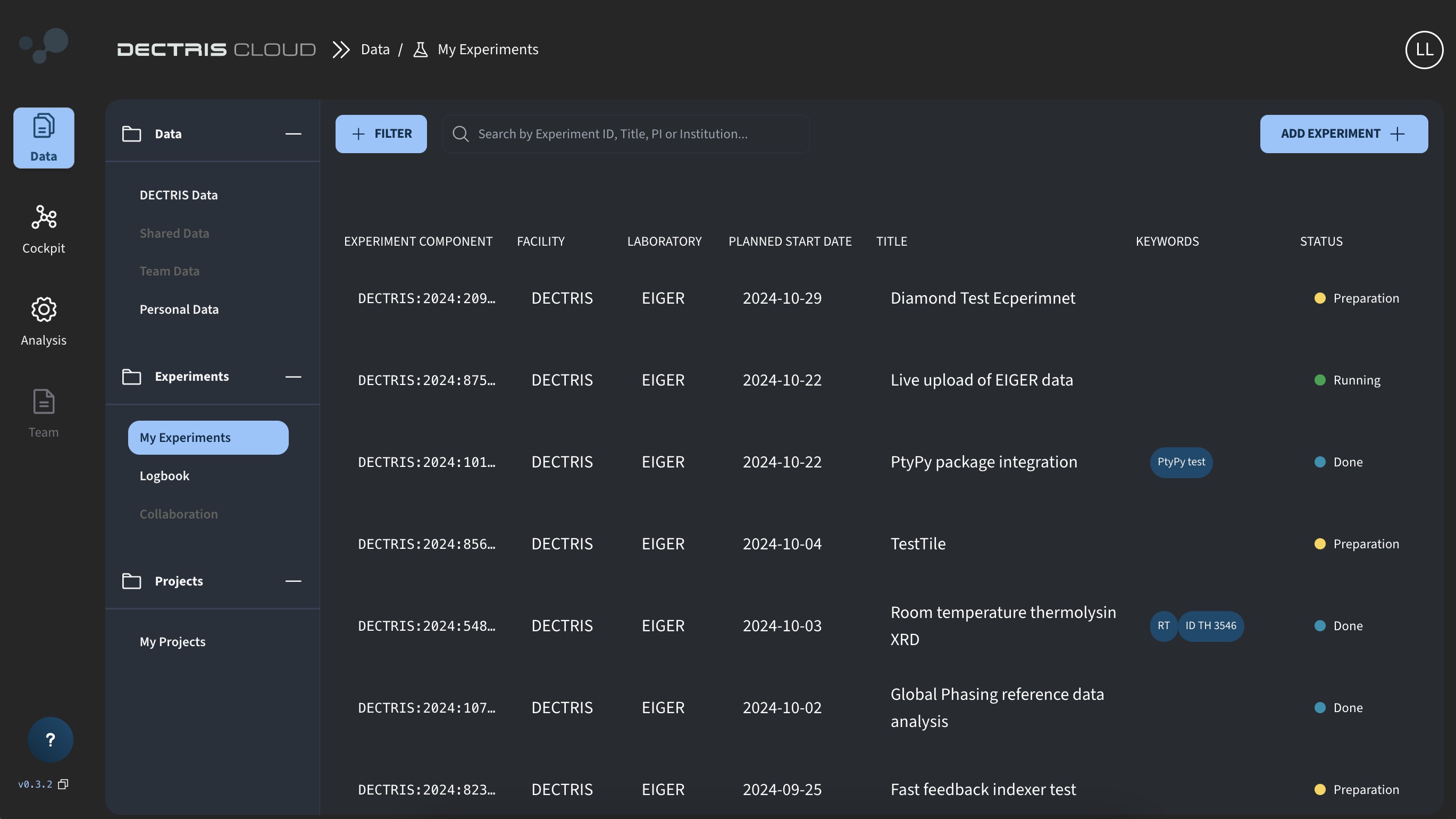
The My Experiments area is a central hub where you can view, manage, and collaborate on your experiments. It provides an organized structure for accessing and working with experiment-related data, fostering a collaborative and efficient workflow. This is the place where your experiments are shown in a comprehensive list:
The Experiment entity
The entity "Experiment" at DECTRIS CLOUD can be seen as a container to all associated data and, in practical terms, corresponds to:
- one visit to a user facility;
- one set of experimental tests performed in a microscope;
- one or a group of datasets acquired in one experiment.
An "Experiment" has the following attributes:
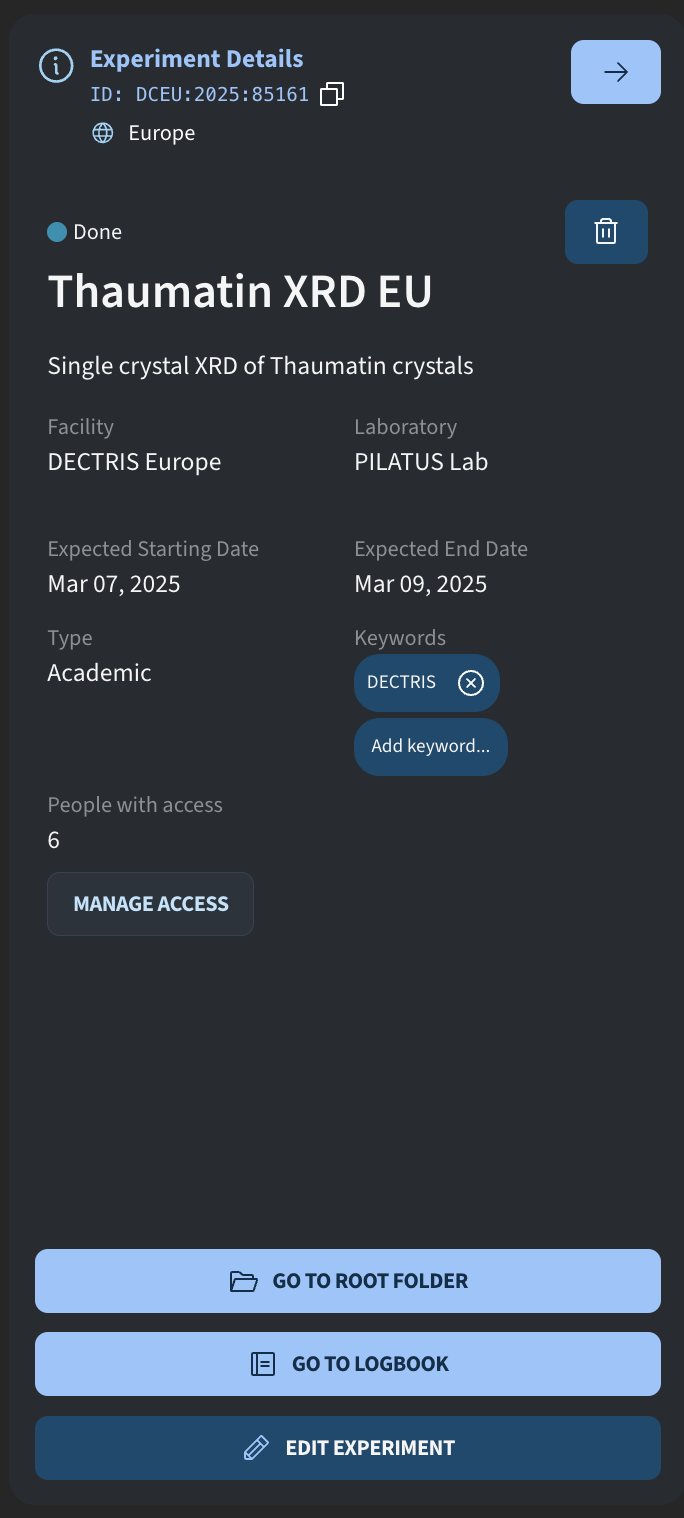
- Experiment ID: consists of the lfacility code, the year in which the experiment was performed and a 5 digit tag that uniquely identify the experiment.
- Facility: the facility where the laboratory in which the experiment was performed is located (e.g.: a synchrotron, a university).
- Laboratory: the laboratory in which the experiment was performed.
- Status: the classification that distinguishes experiments under "Preparation", "Active" or "Done".
- Planned start date: the day in which the experiment is planned to start.
- Expected end-date: the day in which the experiment is expected to end.
- Title: a descriptive title that assists on the identification of that particular experiment.
- Keywords: user defined tags that can be added to experiments to enhance findability via filtering and grouping by custom tags.
- Logbook: a note taking environment uniquely associated to each experiment and accessible editable by all collaborators and by the PI.
Roles
Experiments can be shared with four different roles. Each role includes everything the roles below it can do, plus additional permissions.
- Owner: Full control. Manages all roles and holds legal responsibility for the experiment data, typically the PI or instrument manager. There is exactly one Owner per experiment.
- Manager: Operational management. Can add or remove Members and request deletions of raw data.
- Member: Hands-on contribution. Can upload data, edit the logbook, perform analysis, and add Viewers. Best for PhD students, visiting scientists, and active collaborators.
- Viewer: Read-only access. Can view the uploaded and processed files in the experiment, but cannot access them in sessions and jobs. Best for passive collaborators or anyone who only needs visibility.
Experiment data
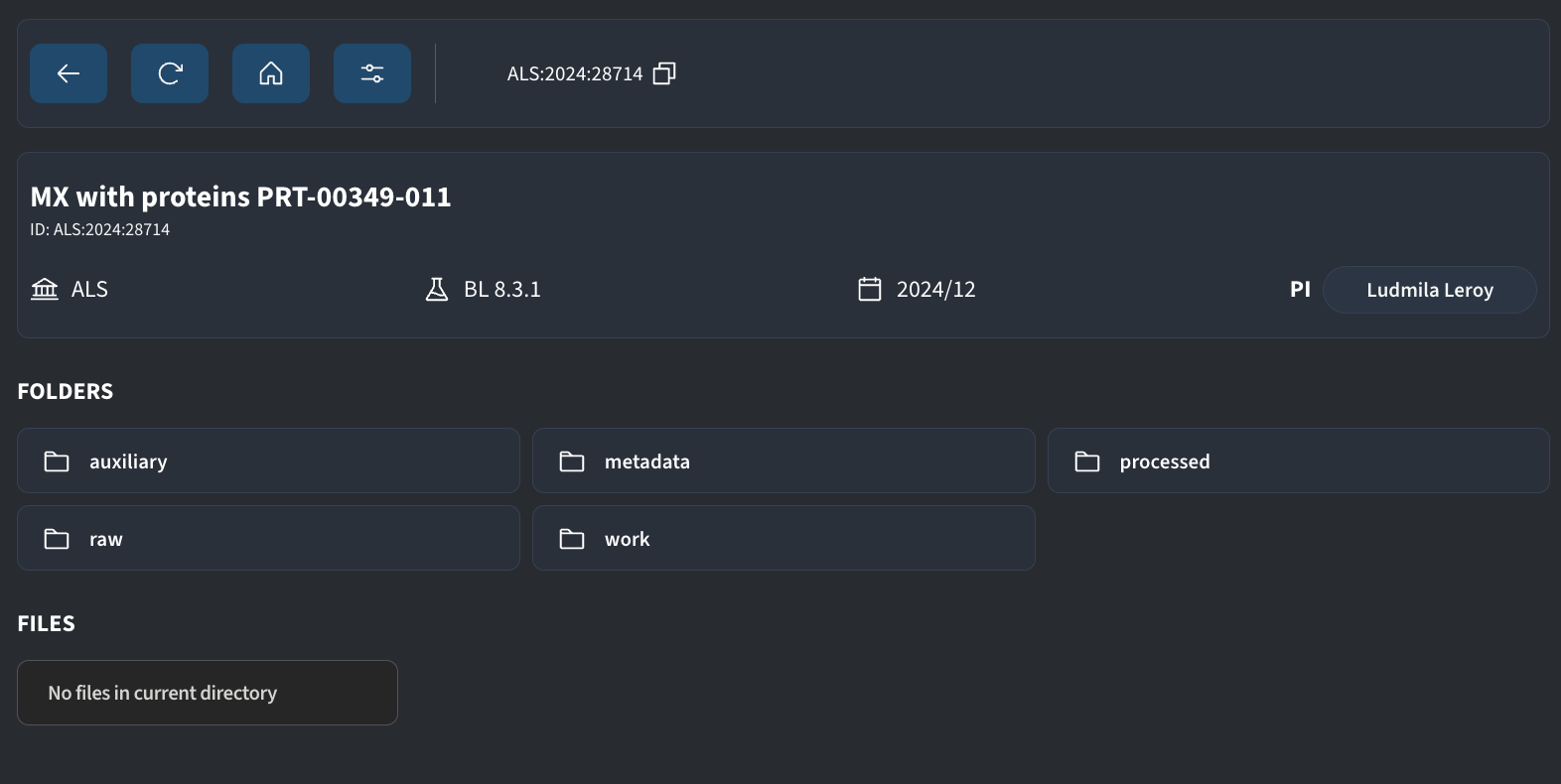
Each experiment serves as a container for all its associated data and the data related to one experiment is organized under its corresponding root folder. The root folder is structured with sub-folders to ensure that one can easily locate raw data, processed results, work-in-progress files, and auxiliary materials. The standard subfolder structure accessible using the filebrowser on the app.dectris.cloud is shown below:
Logbooks
The Logbook is an integrated feature within every experiment, designed to serve as a collaborative space for taking and organizing notes. As each experiment acts as a container for its related data, the associated logbook provides a centralized location for collaborators to document procedures, observations, progress, and key details.
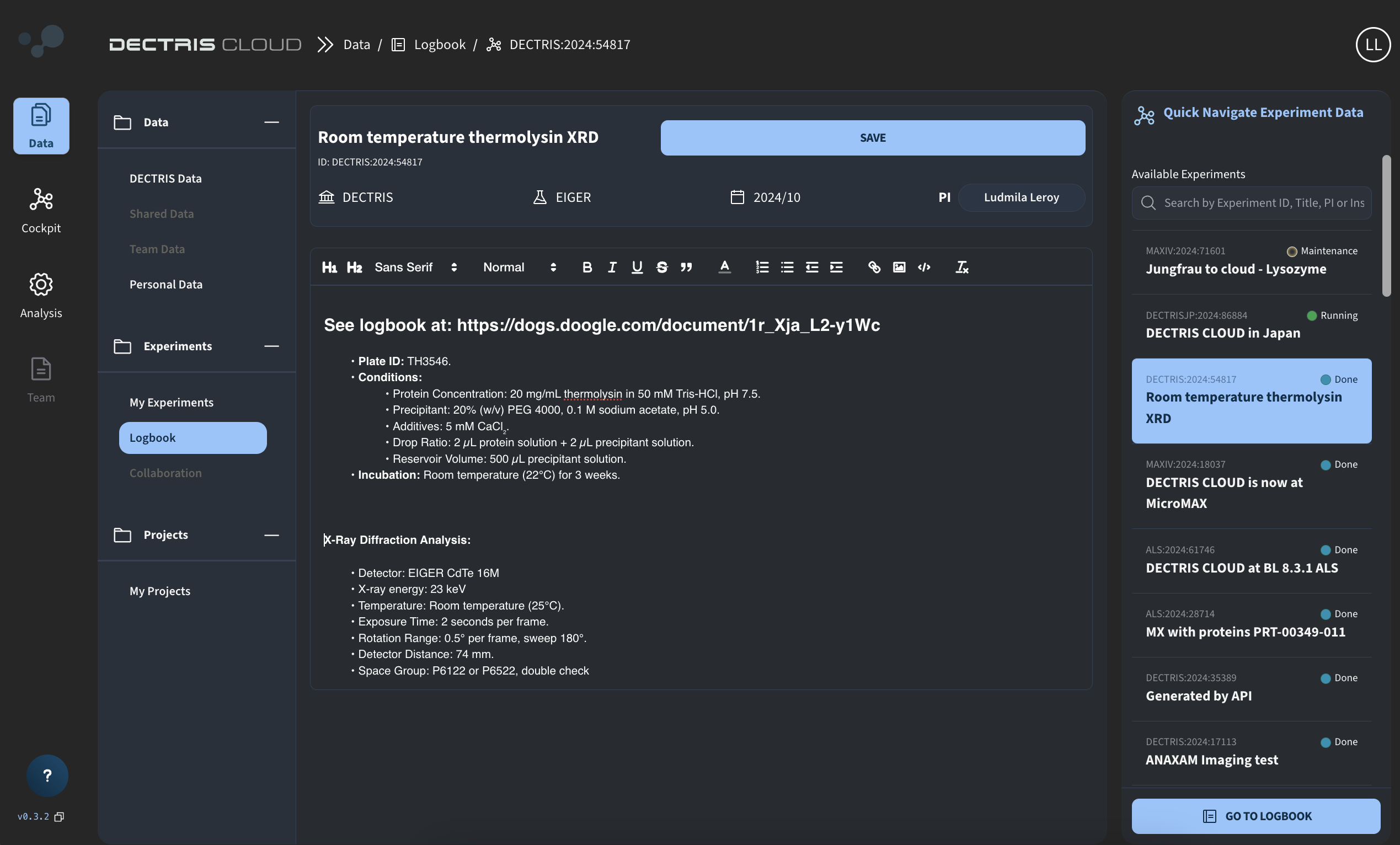
The principal investigator and the collaborators involved in the experiment can all access the experiment's logbook under "Data" --> "Experiments" --> "Logbooks". The simple note taking interface allows key information related to the experiment to be shared among all collaborators automatically. Here are some key aspects that make Logbooks a useful note space for the team:
- All collaborators associated with the experiment have access to its logbook.
- Notes can be created, viewed, and edited by any experiment member above viewer, ensuring real-time updates and contributions.
- The logbook offers a straightforward interface for recording information, making it easy to capture key details without complexity.
- The logbook is directly tied to its respective experiment, ensuring all related datasets and notes are managed in one place.
Simple collaborative note-taking for a dynamic record of the experiment's lifecycle, evolving as the experiment progresses.